백서
OPSL 장점 백서 시리즈 #3:
무모드 노이즈(“그린 노이즈”)
개요
The optically pumped semiconductor laser (OPSL) is a unique, patented technology that provides lower intrinsic noise than other continuous wave (CW) solid state lasers having UV or visible output, and is the only way to achieve true-CW output at 355 nm in a simple, cost-effective platform. The reason is the absence of mode noise due to the near-zero upper state lifetime of the OPSL gain medium.
이 시리즈의 OPSL 장점 백서:
#1. Wavelength flexibility
#2. Invariant beam properties
#3. No mode noise ("green noise")
#4. Superior reliability - huge installed base
성능과 비용 간의 상충 관계 해소
Demanding visible and ultraviolet applications for CW lasers (e.g., pumping CEP-stabilized laser systems, Brillouin scattering, and semiconductor wafer inspection) need a high quality stable output beam with low amplitude noise. Diode pumped solid state (DPSS) lasers can produce the requisite beam quality, albeit only at a fixed output power1, but their noise performance is often limited by a problem called mode noise or “green noise.” Addressing this noise adds laser complexity. In DPSS visible lasers, there is thus a trade-off between performance (noise) and cost (complexity). This critical noise mechanism is completely absent in visible OPSLs which can thus offer lower noise at a reduced cost. It also enables OPSLs to generate noise free ultraviolet output (e.g., at 355 nm) in a simple format. This is a major reason that OPSLs dominate the use of ultraviolet wavelengths in flow cytometry.
1. 이 시리즈의 백서 #2를 참조하십시오.
카오틱 모드의 작동 방식
거시적 공진을 기반으로 하는 연속파 레이저의 출력은 공진기 구조에 크게 좌우된다. 이는 OPSL, 기존 DPSS 레이저 및 대부분의 연속파 가스(이온) 레이저에 해당한다. 공진기 길이가 수십 밀리미터에서 수십 센티미터에 이르는 이러한 연속파 레이저들은 여러 개의 종방향 공진 모드를 지원할 수 있다. 일반적으로 이러한 레이저에서는 공동 내 빔 강도가 각각 약간씩 다른 주파수를 갖는 여러 종방향 모드에 분배된다(그림 1 참조).
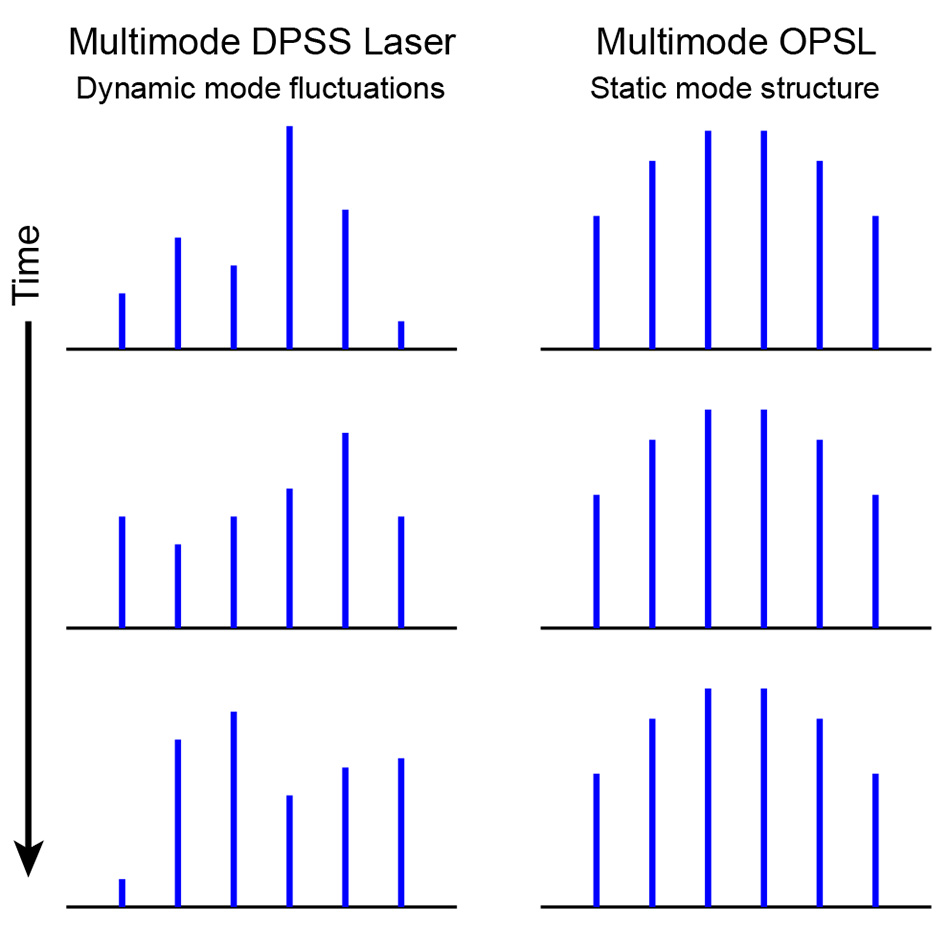
그림 종단모드 동역학:DPSS 레이저와 OPSL의 경우.
그러나 이온 레이저나 DPSS 레이저와 같은 기존 기술의 경우, 전체 동굴 내 출력이 개별 모드들 사이에 분배되는 방식은 상당히 무작위적이고 동적이며, 그림 1에서 볼 수 있듯이 시간이 지남에 따라 다양한 비율로 혼합된 모드들이 발진하며 이용 가능한 저장 이득을 놓고 경쟁하게 됩니다. 하지만 강도 합계는 일정하게 유지되기 때문에, 이온 레이저의 다중 모드 작동 방식은 낮은 진폭 잡음이 요구되는 대부분의 응용 분야에 매우 적합했습니다.
In ion lasers and DPSS lasers, this dynamic competition between the different modes arises because the active laser medium has stored energy. In simple terms, the excited state of the gain medium has a much longer lifetime than the trip time for photons to circulate around the CW cavity. Specifically, the excited state lifetime in Nd-based DPSS lasers is microseconds, whereas the cavity trip time is only nanoseconds. Stored energy is actually an advantage for some pulsed laser applications because it enables a mechanism called Q-switching which generates very short and intense pulses. However, it limits how fast the laser can be modulated (turned on and off). And, just as important, it causes noise problems when using frequency conversion to generate harmonics of the fundamental, e.g., doubling the 1064 nm fundamental wavelength to generate CW green output at 532 nm.
주파수 배가 현상은 녹색(및 자외선) 노이즈를 발생시킨다
DPSS 레이저와 OPSL 모두 근적외선 영역에서 기본 출력을 생성하며, 이 출력은 소위 비선형 결정체를 사용하여 주파수를 2배로 높여 가시광선 출력을 생성하거나, 3배로 높여 자외선 출력을 생성합니다. 이러한 제2고조파 발생(SHG) 및 제3고조파 발생(THG) 과정은 강도, 즉 SHG 또는 THG 결정체 내 단위 면적당 출력에 크게 좌우됩니다. 펄스 레이저의 경우, 피크 출력이 평균 출력보다 몇 배나 더 높을 수 있으므로, 레이저 캐비티 하류, 즉 캐비티 외부에서 효율적인 주파수 배가(및 3배)를 쉽게 수행할 수 있습니다. 그러나 CW 레이저의 경우, 높은 강도를 얻는 유일한 방법은 SHG 및 THG 결정체를 캐비티 내부에 배치하는 것인데, 이곳에서는 순환 출력이 출력 전력보다 최대 두 배나 더 클 수 있습니다. 이제 이전에는 별다른 문제가 되지 않았던 모드 노이즈가 실질적인 문제가 됩니다.
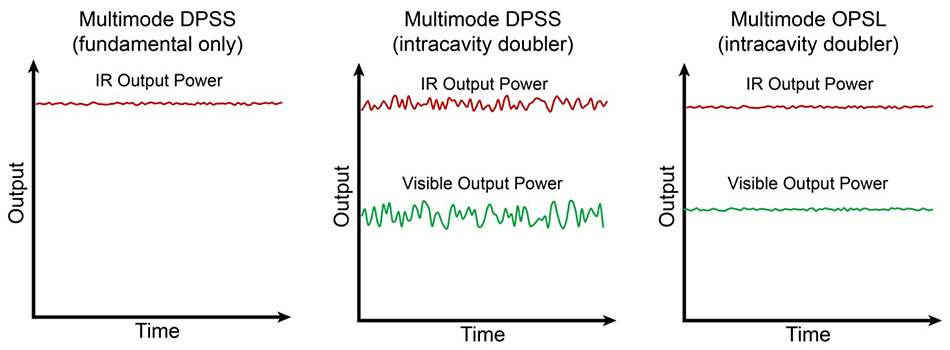
그림 2:CW DPSS 다중 모드 레이저에서는 총 출력이 서로 다른 종방향 모드 간에 동적으로 분배되더라도 일정하게 유지된다. DPSS 공진기에 주파수 배가 결정체를 삽입하면 총 출력에 카오스적인 변동이 발생한다. 이러한 노이즈 현상은 OPSL에서는 발생할 수 없다.
다중 종방향 모드를 갖는 DPSS 레이저의 기본 동조 내 빔에 배가 결정체를 삽입하면 , 기본 출력 및 배가 출력 모두에서 카오스적 강도 노이즈가 발생합니다 ( 그림 2 참조 ) . 그 이유는 제2고조파 발생(하나의 종방향 모드 주파수를 배가하는 현상)과 합주파 발생(두 개의 서로 다른 종방향 모드 주파수를 더하는 현상)이 모두 가능하기 때문입니다. 합주파 발생은 개별 종모드를 결합하여 종모드 간의 직접적인 동적 상호작용을 가능하게 한다. 한 모드의 강도가 다른 모드의 이득에 의존하는 종모드 간의 모든 쌍별 상호작용에서 발생하는 시간적 역학은 상당한 강도 노이즈를 생성한다. 오랫동안 알려져 온 이 현상은 "녹색 문제"라고 불립니다[참조 1]. 이는 공동 내 주파수 배가 방식을 사용한 최초의 널리 보급된 CW 레이저가 녹색 DPSS 레이저였기 때문인데, 이 레이저에서는 1064 nm의 기본 주파수가 주파수 배가되어 532 nm의 녹색 출력을 생성합니다.
CW DPSS 레이저: 성능과 비용의 상충 관계
CW DPSS 레이저에서 모드 노이즈 문제를 해결하기 위해 여러 가지 방법이 사용되어 왔다. 초기 접근 방식 중 하나는 더 많은 종방향 모드에 전력을 분산시키기 위해 길쭉한 공진기를 사용하는 것이었다. 이 아이디어는 훨씬 더 많은 모드의 노이즈 효과를 평균화함으로써 노이즈 수준을 낮추는 것입니다. 이러한 “스미어링(smearing)” 방식은 일부 응용 분야에서는 충분하지만, 캐리어 엔벨로프 위상(CEP) 안정화와 같이 노이즈에 특히 민감한 응용 분야에서는 불충분한 것으로 입증되었습니다. 또한 당연히, 단색성, 즉 좁은 스펙트럼 대역폭에 의존하는 응용 분야에는 부정적인 영향을 미칠 수 있습니다.
더 철저한 접근 방식은 녹색 노이즈를 발생 원천에서 직접 제거하는 것입니다. DPSS 레이저에서 이를 수행하는 가장 직접적인 방법은 에탈론(etalon)과 같은 광학 소자를 사용하여 레이저가 단일 종모드(longitudinal mode)로 작동하도록 하는 것입니다. 이를 위해서는 동굴(cavity)의 능동적 열 안정화뿐만 아니라, 피에조 미러 마운트와 피드백 전자 장치를 활용해 동굴 길이와 에탈론의 성능을 연동시키는 기술이 필요합니다. 이 모든 과정은 비용과 복잡성을 가중시킵니다.
일부 상용 저잡음 DPSS 레이저는 다른 능동적 피드백 잡음 저감 방식을 기반으로 합니다. 하지만 어떤 경우든 잡음, 비용, 복잡성 사이에는 피할 수 없는 상충 관계가 존재합니다.
OPSL – 저소음 가시광선 출력 제공
With OPSLs, the gain dynamics are completely different. The gain medium is a semiconductor where pump light creates holes and electrons inside quantum wells. Radiative and non-radiative recombination of these charge carriers are both very fast processes. So in an OPSL, the effective upper state lifetime is a few nanoseconds or less, i.e. on the timescale of the cavity trip time. This has two benefits. First an OPSL can be directly modulated at speeds up to 100 kHz. And more importantly, the short upper state lifetime means there is no stored energy on the laser mode timescale – only instantaneous gain. Where the OPSL is operating on multiple longitudinal modes, the behavior of these cavity modes therefore is determined solely by the cavity, the gain just follows along. The distribution of power among these modes is thus stable with time.
Because the power distribution is completely stable, there is no noise due to non-linear coupling between the longitudinal modes when an intracavity doubling crystal is used to create visible output. The green problem simply does not exist in OPSLs because of the short upper state lifetime. Since there is no need for noise suppression mechanisms with their associated cost and complexity, there is no trade-off between performance and complexity (cost, potential failure modes). Of course, OPSLs can be designed for a single mode operation, and Coherent offers these for applications such as interferometry. But with OPSLs, single-mode is an option for these high coherence applications, not a prerequisite for low noise.
OPSL, 진정한 연속파(True-CW) 자외선 출력 제공
Frequency tripling can be used with DPSS and OPSLs in order to produce ultraviolet output. As with visible lasers, Q-switched DPSS lasers can use extracavity harmonic generation with excellent efficiency. This is the basis of several industrial nanosecond lasers produced by Coherent for precision materials processing applications. But with CW operation, the green noise problem manifests as a UV problem with increased severity because the tripling efficiency is determined by the third power of the focused intensity. For applications where quasi-CW output is acceptable, such as laser direct imaging of printed circuit boards, the DPSS laser can be mode-locked with a repetition rate of tens of MHz. An example is the Paladin series of lasers where the high peak power of the picosecond pulses means that extracavity tripling is very efficient. However for applications such as data storage and live cell sorting the pulsed output and/or high peak power of pseudo-CW operation can be a problem. Again OPSL technology provides an optimum solution without resorting to noise suppression mechanisms such as stabilized single-mode operation. For example, the Genesis 355 laser is now the accepted standard for the growing demand of flow cytometry applications requiring UV output, e.g., to excite endogenous fluorescence from DNA.
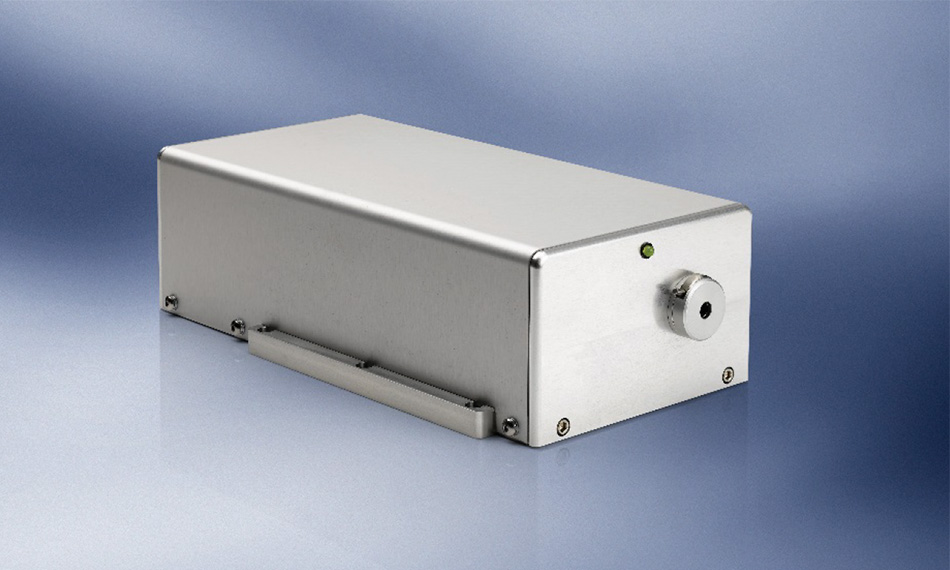
Figure 3: The Genesis 355 is a low-noise ultraviolet (355 nm) OPSL that delivers true CW output with very low noise for applications such as flow cytometry.
요약
1세대 연속파 고체 레이저는 DPSS 기술을 활용했습니다. 이 기술을 통해 가시광선 및 자외선 출력을 얻는 데는 ‘그린 노이즈’라고 불리는 현상이 걸림돌이 되어, 성능(저잡음)과 복잡성(비용 및 잠재적 고장 모드) 사이에서 절충점을 찾아야 했습니다. OPSL에서는 이러한 노이즈의 근본적인 원인이 완전히 제거되었습니다. 그 결과, 다중 모드 가시광선 및 자외선 OPSL은 추가적인 복잡성이나 비용 부담 없이 우수한 노이즈 특성을 제공합니다.
참고 문헌
1. T. Baer, Large amplitude fluctuations due to longitudinal mode coupling in diode-pumped intracavity-doubled Nd:YAG lasers, J. Opt. Soc. Am. B, vol 3, 9, pp 1175-1180 (1986).