What is a Powell Lens?
파웰 렌즈 균일한 강도의 레이저 선을 생성하는 데 사용되는 광학 파웰 렌즈 . 이를 위해 독특한 원통형 비구면 표면 형태를 채택하고 있습니다. 파웰 렌즈 머신 비전부터 유세포 분석 이르기까지 다양한 분야에서 파웰 렌즈 .
대부분의 레이저는 원형 또는 타원형 단면의 빔을 방출합니다. 빔 전체에 걸친 강도 프로파일은 일반적으로 가우시안 분포를 따르거나 거의 이에 가깝습니다. 이러한 가우시안 강도 분포는 많은 응용 분야에서 유용합니다. 그러나 균일한 강도 분포(흔히 "플랫탑"이라 함)가 더 바람직한 경우도 있습니다.
There are several ways to convert a Gaussian beam into a uniform intensity distribution (in both one and two dimensions). The most powerful and flexible way is based on the Powell lens. Let’s look at why flat-top beams are sometimes needed, how the Powell lens works, and what benefits it offers over other technologies.
가우시안 빔 – 장점과 단점
이 그림은 원형 가우시안 빔을 보여줍니다. 이 빔은 가장자리보다 중심부에서 훨씬 더 강합니다. 가우시안 빔은 대부분의 레이저를 뒷받침하는 물리학의 자연스러운 결과이므로 매우 흔합니다.
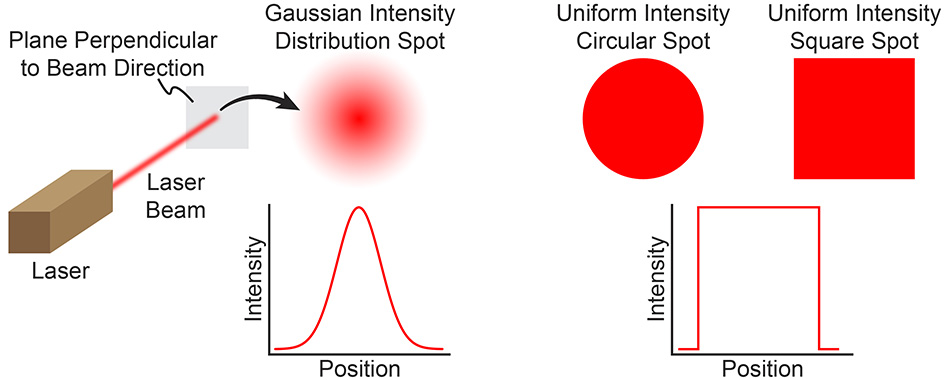
대부분의 레이저는 자연스럽게 가우시안 강도 분포를 가진 원형 단면 빔을 생성합니다. 이는 중심부가 가장자리보다 훨씬 밝습니다. 비교를 위해 원형 및 사각형의 균일한 강도 빔이 표시됩니다.
가우시안 프로파일 빔은 여러 가지 이유로 균일한 강도의 빔(원형 또는 사각형)보다 종종 유리합니다. 핵심적인 이유는 동일한 직경의 균일한 원형 빔보다 가우시안 빔이 더 작은 스팟으로 초점 조절이 가능하기 때문입니다. 이는 많은 응용 분야에서 매우 유용합니다. 예를 들어, 대부분의 재료 가공 용도에서 더 작은 초점 빔은 미세한 특징을 생성하는 능력을 향상시킵니다. 많은 레이저 기반 현미경 기술에서 더 작은 초점 스팟 크기는 이미지 해상도를 높입니다.
그러나 반대인 경우도 있는데, 특히 레이저가 선형 빔(가로보다 세로 길이가 긴 빔)로 형성될 때 그러합니다. 선형 빔은 다양한 조명 작업에 사용됩니다. 여기서 균일한 강도는 바람직합니다. 장면이나 물체를 고르게 비추면 후속 이미지 처리가 단순화되고 이미지 대비와 해상도가 향상되기 때문입니다.
가우시안 빔 변환
가우시안 빔의 독특한 특성은 전통적인 광학 장치를 사용하여 초점을 맞추거나 확장하거나 다른 방식으로 재형상화할 때도 가우시안 강도 프로파일을 유지한다는 점이다. 실제로 이를 제거하는 것은 상당히 어렵다.
가우시안 빔을 균일한 강도 분포를 가진 빔으로 변환하는 가장 간단하고 직접적인 방법은 빔을 중앙부(가장 균일한 부분)를 제외한 나머지를 차단하는 개구부를 통과시키는 것이다. 이 방법에는 두 가지 단점이 있다. 첫째, 레이저 출력의 상당 부분(최대 75%)이 손실된다. 둘째, 결과적으로 생성된 빔은 여전히 완전히 균일하지 않다.
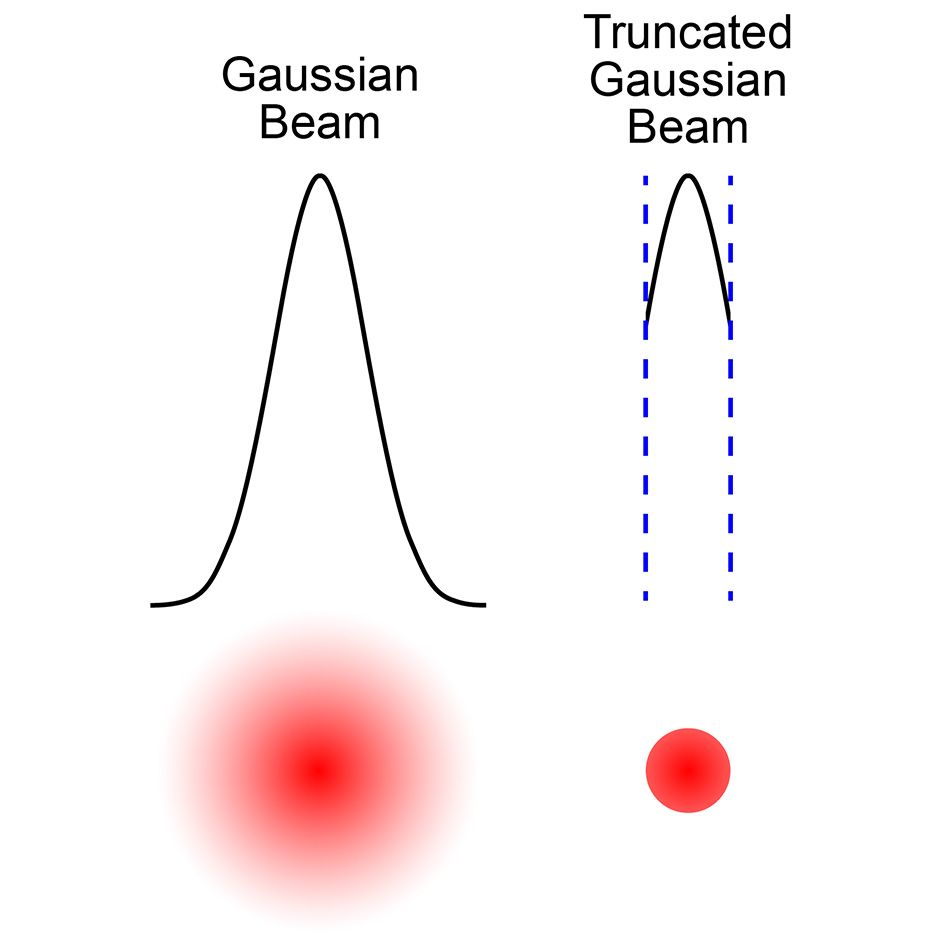
가우시안 빔을 균일한 강도 프로파일로 변환하는 가장 간단한 방법은 빔의 중심 부분만 선택하고 나머지는 버리는 것이다. 그러나 이 방법은 최악의 결과를 초래한다.
가우시안 빔을 많은 빛을 낭비하지 않고 평탄한 상단 분포로 변환하는 것은 더 어렵습니다. 그러나 회절 및 굴절 기술을 모두 사용하여 이를 달성할 수 있습니다.
Diffractive optics work by creating interference between various diffracted orders to spatially redistribute the light in a laser beam. This can produce virtually any arbitrary intensity profile, including nearly flat-top, as well as a wide variety of patterns.
There are two big negatives of diffractive optics for making uniform line beams. First, they’re not very efficient. They lose a fair amount of light into unwanted diffraction orders. Second, they are typically very wavelength-sensitive. This is particularly problematic when using them with diode lasers.
Lenslet arrays are a purely refractive approach. These are optics containing multiple lenses, each much smaller than the input beam. The output pattern produced by each lenslet overlaps in the far field, creating the desired uniform intensity distribution.
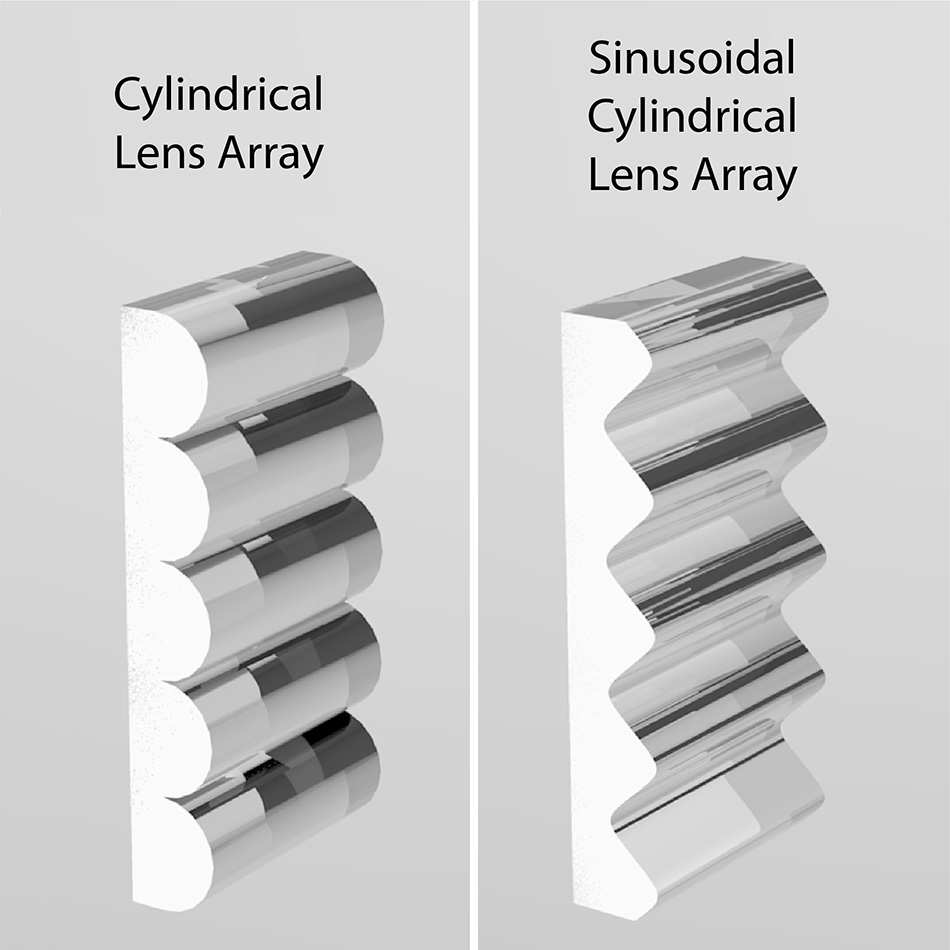
Two configurations of cylindrical lenslet arrays.
It’s very difficult to achieve a high degree of uniformity in the final beam with lenslet arrays. There is usually a substantial amount of high-frequency ripple in the intensity. Additionally, lenslet arrays also require specialized tooling to produce, limiting their usefulness to high-volume applications.
The Powell Lens
Powell lenses are another type of refractive optic that overcomes the limitations of both diffractive optics and lenslet arrays. The Powell lens is an aspheric cylindrical lens shaped specifically to efficiently transform a Gaussian input beam into a diverging beam with a uniform intensity distribution. Because a Powell lens is a type of cylindrical lens, it only homogenizes the beam in one dimension.
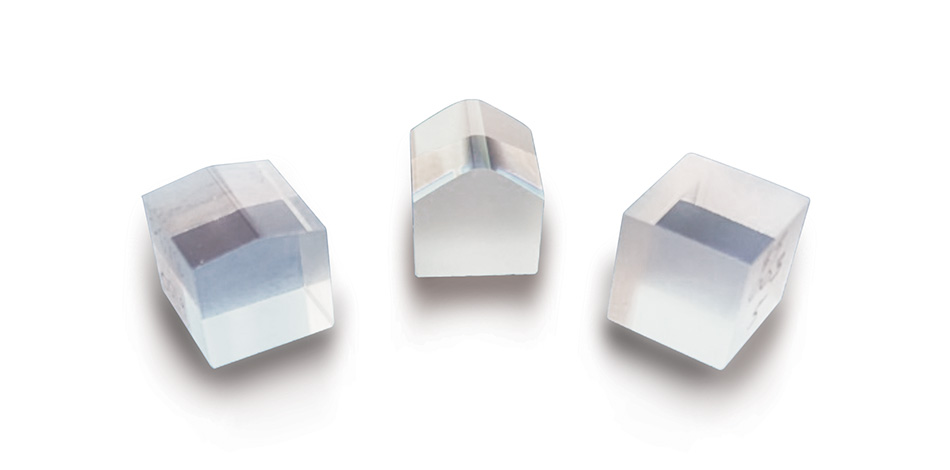
Powell lenses.
The figure illustrates the shape of the Powell Lens surface and compares its operation with that of a traditional cylindrical lens. The Powell Lens redirects light from the center to the edge of the beam in order to eliminate the central “hot spot.” The cylindrical lens also causes the beam to fan out in one dimension but preserves its Gaussian profile. So, it produces a line beam that is much brighter in the center than at the edges.
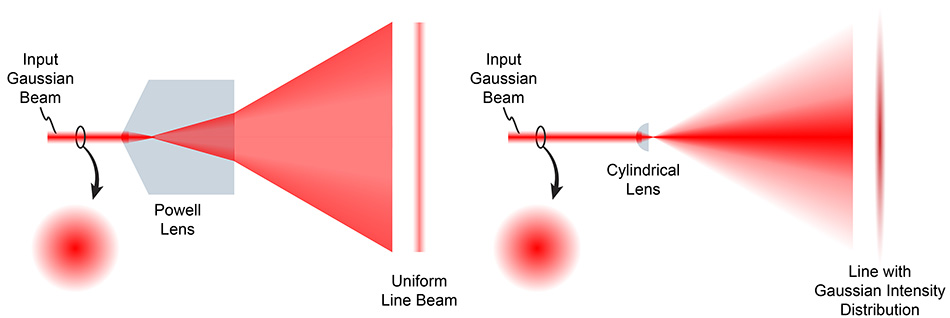
The Powell lens (left) is compared to a traditional cylindrical lens (right). Both optics transform a round Gaussian profile laser beam into a diverging fan of light which makes a line on any surface on which it is projected. The Powell lens shifts light from the center to the edge of the beam to produce a uniform intensity line, while the cylindrical lens maintains the Gaussian profile of the beam, so its line is much brighter in the center.
The Powell lens delivers superior results over diffractive optics in almost every aspect of performance. Most importantly, the Powell Lens is more efficient (loses less light), and produces a steep-edged pattern, with little light outside the desired region.
This Powell lens is also fairly insensitive to input wavelength. This makes it usable with diode lasers, since it is unaffected by unit-to-unit variations in wavelength, as well as the inherent bandwidth and wavelength temperature dependence of these sources. The result is that an overall intensity uniformity of ±5% over the entire pattern can be routinely achieved in production beam homogenizers without having to wavelength select or bin diode lasers.
Powell lenses aren’t perfect, though. Each is designed for a specific input beam diameter and won’t produce optimal results with larger or smaller beams. They are also sensitive to alignment (in the axis perpendicular to the cylindrical surface). Misalignment reduces the intensity uniformity of the projected line.
Understanding Powell Lens Specifications
Fabricating the cylindrical asphere on a Powell lens with high precision is challenging, and the quality of Powell lenses varies between manufacturers. This means the performance of a real-world Powell lens may depart significantly from its design values. This makes it important to know how to read published specifications.
The primary specifications for a Powell lens are its operating wavelength, intended input beam diameter (which is defined to be at the 1/e² intensity points, since the input beam is Gaussian), and output beam fan angle. These are shown schematically in the drawing. Since the output beam is intended to be uniform, and not Gaussian, the fan angle is measured at the point at which the power has dropped to 80% of its peak value (rather than the 1/e² power point).
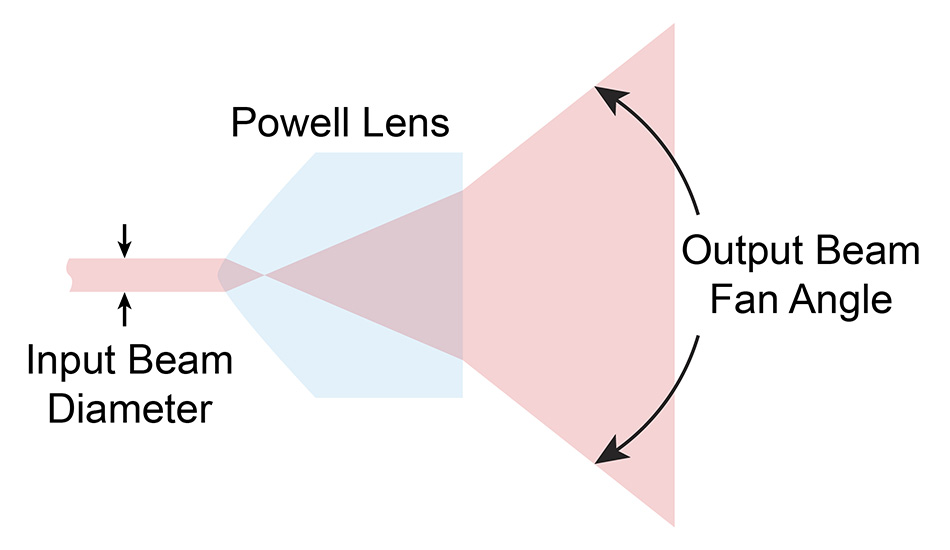
Primary nominal specifications for a Powell lens are the input beam diameter and output beam fan angle.
Typically, the most important performance parameter for a Powell lens is its intensity uniformity. Manufacturing variations and tolerance effects can produce intensity variations (particularly at the beam edges), non-flat top profiles, periodic structure, and scatter.
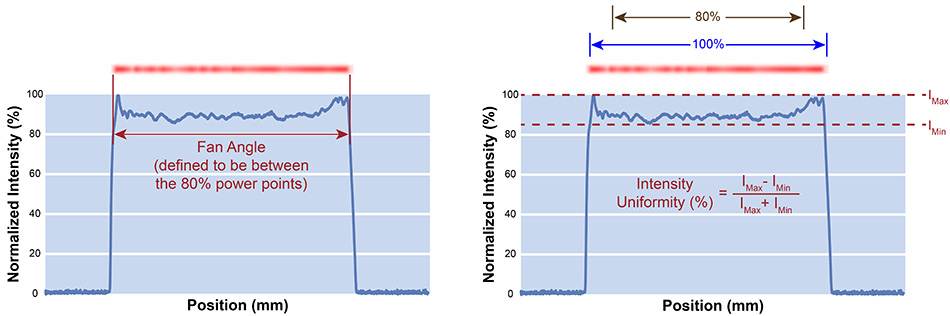
Power lens fan angle is usually measured from the points at which the intensity has dropped to 80% of its peak value. Intensity uniformity is specified differently by various manufacturers.
대부분의 제조사는 선형 균일성을 앞서 제시된 도면의 공식으로 정의합니다. 그러나 일반적으로 이 사양은 선형의 중앙 80%(도면에도 표시됨)에만 적용됩니다. 그러나 빔의 가장자리를 제외하면 실제 성능을 비현실적으로 묘사하게 되는데, 이는 비균일성이 가장 두드러지게 나타나는 부분이 바로 가장자리이기 때문입니다.
In contrast, Coherent applies the intensity uniformity specification over 100% of the line length. The same applies to our specifications for line straightness and contained power (the ratio of power contained in the line between the 80% and the 1/e² peak power points). This is a much more stringent and difficult-to-meet specification. The result is the Coherent Powell Lens deliver better measurement accuracy, signal-to-noise ratio, and unit-to-unit consistency.